
Growing Up with Nippy
Growing Up with Nippy
Eight stories from Nippy’s childhood, with notes for parents and carers
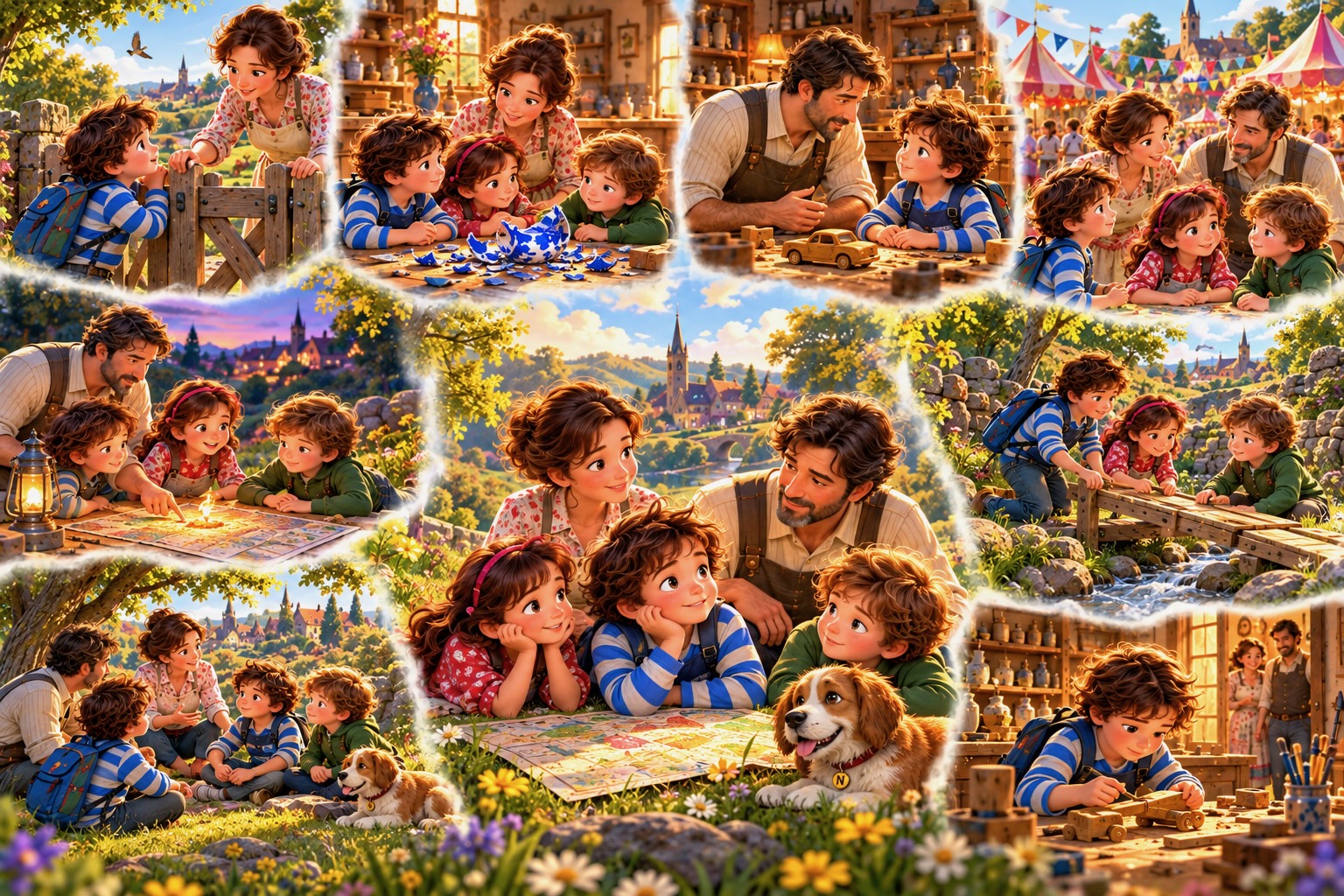 Every family makes hundreds of decisions, and wise parents don’t make them all the same way. Sometimes a parent must say no at once and explain later. Sometimes it helps to ask what happened first. Sometimes the whole family should decide together. And sometimes the kindest thing a parent can do is step back and let a child choose for themselves.
These eight stories follow on from Nippy of Play Vale, and show Nippy, Daisy and Jesse growing up in a house next to an incredible workshop. In each one, Edwin and Martha face an ordinary family moment: a gate left open, a broken vase, a quarrel between brothers, a fair, a gift, a new friend, an expedition, a birthday. Each time, they choose a different way of deciding.
The eight ways of deciding come from the Parenting Judgement Indicator (PJI), which is described in another section of this website. The PJI explores eight parenting styles, arranged in four pairs:
– Directive: the Chief and the Questioner
– Consultative: the Personal Coach and the Family Coach
– Participative: the Guide and the Equal
– Delegative: Hands On and Hands Off
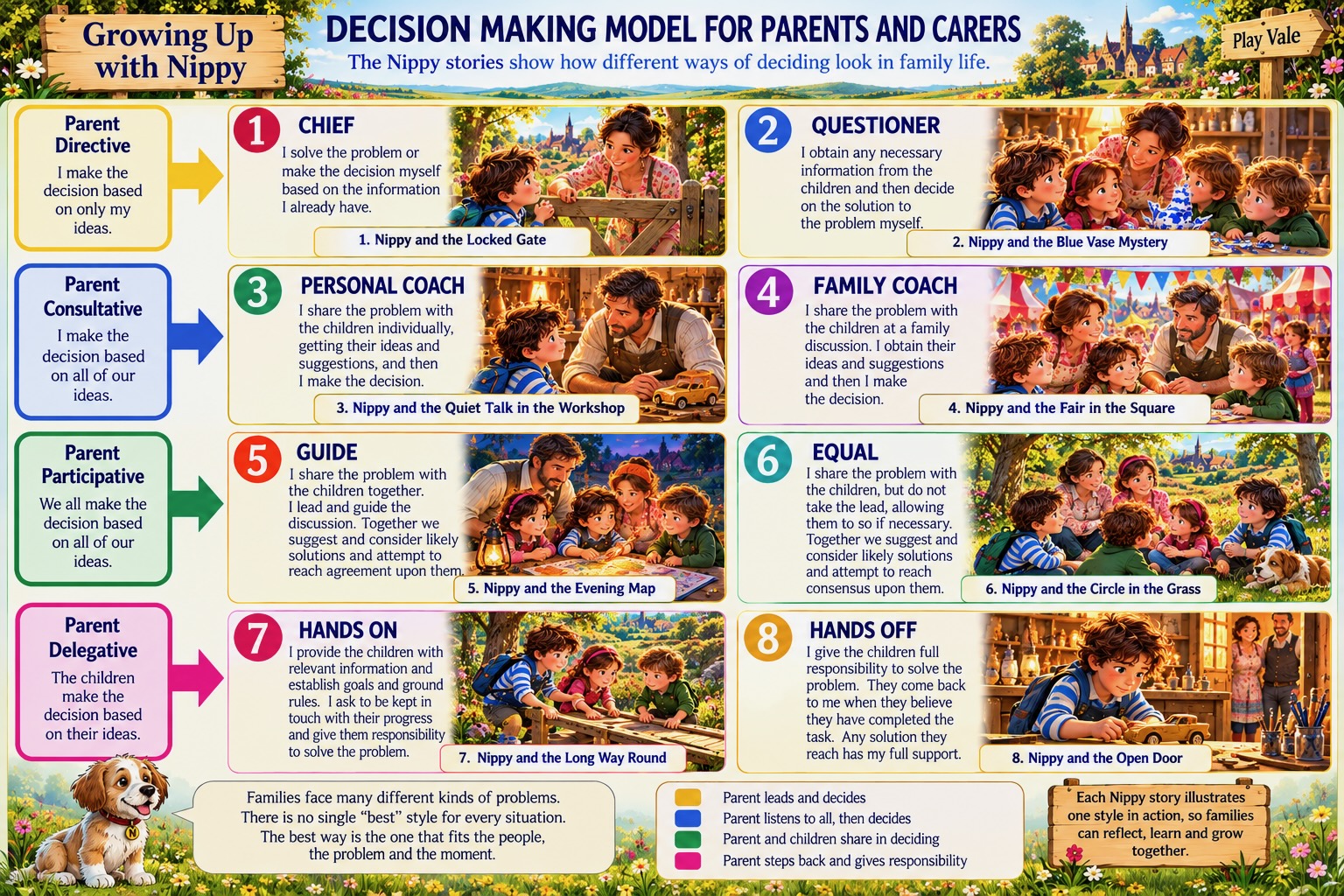 No style is best in itself. The skill is judgement: recognising what kind of moment this is, and choosing the approach that fits.
The stories are written to be enjoyed by children. Each one shows its style through what happens rather than explaining it, and through small parallels from nature and village life: a hen sheltering her chicks, a staked young tree, scout bees dancing, a robin teaching its fledgling to find food.
After each story, a short note for parents and carers explains the style, when it is the right choice, and what goes wrong when it is overused or avoided. It ends with questions to reflect on and questions to share with your child.
The stories are best read in order. Nippy grows older through the collection, and the styles move step by step from parents deciding alone to children deciding for themselves. The same parents who closed the gate are the ones who leave the door open.
These are not therapy tools or teaching scripts. They are stories, shaped by a working life as a child and educational psychologist, and by the warmth of telling stories to grandchildren.
© Michael Lock, 2026. All characters, settings and stories on this website are original works of fiction. No part of these stories may be reproduced without permission.